PANOPTES: Illuminating Bhutan’s STEM Curriculum
Abstract
I participated in building and deploying a research grade exoplanet detector at Samtse College of Education in 2023. It was a life and career changing experience. I was fascinated by its mission to unite professional astronomers, citizen scientists, and schools in a joint effort to create observatories worldwide to discover and study numerous exoplanets. This initiative presents a valuable opportunity for us, as Bhutanese citizens, to play a significant role in advancing scientific knowledge in this field. This paper discusses the use of PANOPTES to encourage STEM participation within the Bhutanese school system.
Background: My Experience with Project PANOPTES
From a young age, I have been very interested in astronomy and spirituality, often pondering questions such as: “Are we alone in the universe?” and “What is the purpose of life?” Therefore, being part of Project PANOPTES has been a surreal and amazing learning experience for me, and I feel like I am living my dream. Embarking on the project, I was excited to learn that we could create a small automated robotic telescope using just DSLR cameras and software, enabling us to discover exoplanets using the transit method. I gained hands-on experience in software,
hardware, and networking. I installed the Ubuntu operating system on a Raspberry pi, did soldering, and made circuit connections. I set up a network router along with IP addresses and port forwarding. All these skills were crucial for assembling the control box, camera box, mount
and pier. This instilled technical proficiency, fostering genuine engagement.
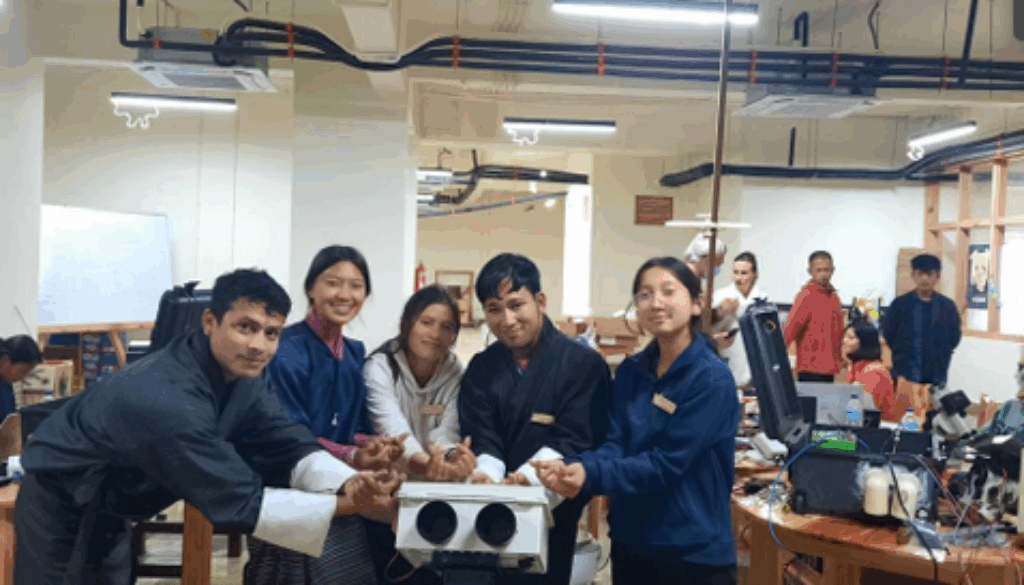
The PANOPTES online forum and weekly zoom meetings with global participants added a dynamic dimension to my learning, providing valuable feedback and support. Serving as a mentor for class XI students at The Royal Academy in building and deploying a new PANOPTES unit
was a gratifying experience as it made me realize the need for authentic experiences in STEM education (see Figure 1).
The installation of the PANOPTES unit at the Karmaling Observatory in Samtse college of Education provided me with the foundational networking knowledge, enabling successful remote access globally. So, not only could I, as a scientist, do my own research with the unit, I now had a research grade instrument that I, as a teacher, could utilize for science instruction with my students.
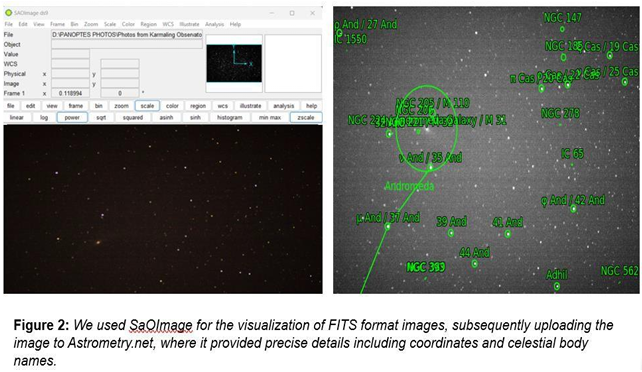
Capturing celestial images from Phuentsholing sharpened my skills with software like FileZilla, SaO Image and Stellarium, addressing the motivation gap in STEM education with authentic scientific practice. Monitoring the PANOPTES unit at Caltech, USA, connected me globally,
showcasing PANOPTES’ far-reaching impact. Project PANOPTES enabled local contributions and fostered connections with renowned universities, offering a global perspective on astronomical research, exemplifying an authentic and influential future in STEM education and research in Bhutan.
My Epiphany
Now leveraging this wealth of knowledge, I, as a teacher, envision PANOPTES as a powerful tool to enhance STEM education in Bhutan. While I personally find astronomy concepts intriguing, I’ve encountered challenges in effectively teaching these concepts using traditional methods such as textbooks or even YouTube videos. Explaining abstract concepts like the Big Bang or the vast distances of celestial bodies, such as the Andromeda galaxy, can leave students confused.
However, PANOPTES presents a transformative solution by allowing students to remotely capture images of the Andromeda galaxy, turning abstract theories into tangible and experiential learning opportunities.
In Bhutan, STEM education faces challenges due to limited resources for practical classes, leading to a reliance on lectures thus diminishing student interest. PANOPTES emerges as a solution, requiring only a laptop and internet access, readily available in schools. This system enables students, even from home, to control the PANOPTES unit, capturing images of the night sky and exploring celestial details. This hands-on experience with hardware and software components cultivates a sense of ownership, promoting lifelong learning and global community
connections through forums and virtual meetings. Beyond imparting technical skills, this educational approach instills virtues like patience and perseverance, fostering a collaborative spirit and nurturing 21st century skills such as effective communication, problem-solving, decision
making, critical thinking and creativity. Thus, it holds significant value for integration into the Sobit Pradhan1* Thrimshing Higher Secondary School
Bhutanese curriculum, inspiring greater interest in STEM subjects and promoting STEM education.
PANOPTES and the Bhutanese curriculum, a solution for improving STEM Education
Bhutan’s National School Curriculum is structured into five key stages: key stage I (PP-III), key stage II (IV-VI), key stage III (VII-VIII), key stage IV (IX-X), and key stage V (XI-XII). Structured around four strands – Working Scientifically, Life Processes, Materials and Their Properties and
Physical Processes, the science curriculum spans key stages I to V. Students initially dive into general science in key stage I, progress to integrated science in key stage II and III and subsequently from key stage IV and V, they learn science in three disciplines: Biology, Chemistry
and Physics.
Integrated science introduces foundational concepts in Astronomy, covering topics such as the Earth’s rotation and revolution, planetary motion, solar and lunar eclipses and the formation of the
solar system. However, more advanced astronomy concepts, including telescopes, the Big Bang theory, solar nebula theory, big crunch, oscillating universe theory, cosmological redshift, cosmic microwave background, particle physics are reserved for the IX-XII Physics curriculum.
In 2021,the Department of Curriculum and Professional Development (DCPD), developed the National School Curriculum (NSC), incorporating Space Physics into classes IX-XII Physics. Space Physics encompasses moon exploration (Class IX), space exploration (Class X), space
technology and application (Class XI) and satellite development (Class XII). The NSC Framework outlines key stage-wise competency-based standards and class-wise competencies, providing instructional guidelines (IG) in softcopy form. These IG, not prescriptive but suggestive, empower
teachers to employ diverse strategies and tools at each key stage.
Building upon the foundational understanding of different types of telescopes and moon exploration gained in class IX and in class X regarding spacecraft, the Mars mission and habitable planets, introducing PANOPTES in class XI and XII is a natural extension. By this point, students have a solid foundation in space physics and astronomical principles. PANOPTES as a cutting- edge technology, allows students to delve deeper into the scientific principles behind detecting
exoplanets through a project-based approach. Engaging in building and/ or remotely controlling PANOPTES units enables students to grasp the functions of advanced telescopic systems. Furthermore, participating in PANOPTES data analysis projects enhances competency and
encourages students in ongoing astronomical research. This involvement aligns with His Majesty the King’s vision of integrating STEM as a universal language for the younger generation, contributing to the development of nationally rooted and globally competent citizens. PANOPTES goes beyond traditional education by instilling 21st century skills through authentic science experiences. Authentic science refers to scientific practices that resemble how scientists conduct their work (Insa et al., 2021). It involves students actively participating in real-world scientific
investigations, where they formulate hypotheses, design experiments, collect and analyze data, and communicate their findings (Broder et al., 2019). This hands-on approach cultivates critical thinking, deepening students’ grasp of scientific nature. They appreciate research complexities
and uncertainties, understanding evidence’s role in supporting or refuting claims.
The Bhutan Baccalaureate learning process emphasizes learning skills, processes and watermarks through a cross pollination approach, where teachers and students collaboratively identify connections between concepts. PANOPTES aligns with this method by fostering cross-
pollination as it not only teaches about exoplanets and stars but also enhances artistic skills through astrophotography. The curriculum integrates historical context, like the seven-star Pleiades constellation, aligning with Bhutanese beliefs about the seven sisters. This approach
deepens students’ understanding by connecting scientific knowledge with real life situations and cultural traditions. Since every school in Bhutan is equipped with at least one laptop featuring WiFi and an Ethernet
cable, managing PANOPTES units becomes a feasible endeavor. By allowing access to PANOPTES units at Samtse College of Education and the Royal Academy along with training teachers and students in the required software and coding, remote control of the PANOPTES
units becomes achievable. This not only enables students to effortlessly monitor and control the PANOPTES unit from any part of the country with reliable internet connection but also proves the project’s cost effectiveness.
As students across Bhutan gain hands-on experience in remotely managing PANOPTES units, there are chances of growing interest in building them. To nurture this enthusiasm, additional units should be established in the near future. Experienced builders from existing units can guide and supervise this expansion, fostering continuous engagement and skill development among aspiring students.
Currently, three PANOPTES units are operational in Bhutan, with two strategically located at the Royal Academy in the north and one at Samtse College in the south. To ensure widespread
participation, installing PANOPTES units in Bhutan’s western and eastern region is crucial. This strategic placement allows students from all corners to engage in building units, fostering a sense of scientific exploration. Moreover, it strengthens our collective endeavor in detecting exoplanets,
turning the unit building process into a valuable learning experience.
Conclusion
This paper introduces the potential of utilizing PANOPTES into the national discussion on the use of authentic science as the stimulus for engaging STEM Education in Bhutan.