We’re thrilled to announce the launch of our PANOPTES Newsletter — a space to share discoveries, creativity, and collaboration from across our growing global network. This newsletter will be publishedmonthly and will highlight the incredible work being done by our partners, students, and teams around the world…
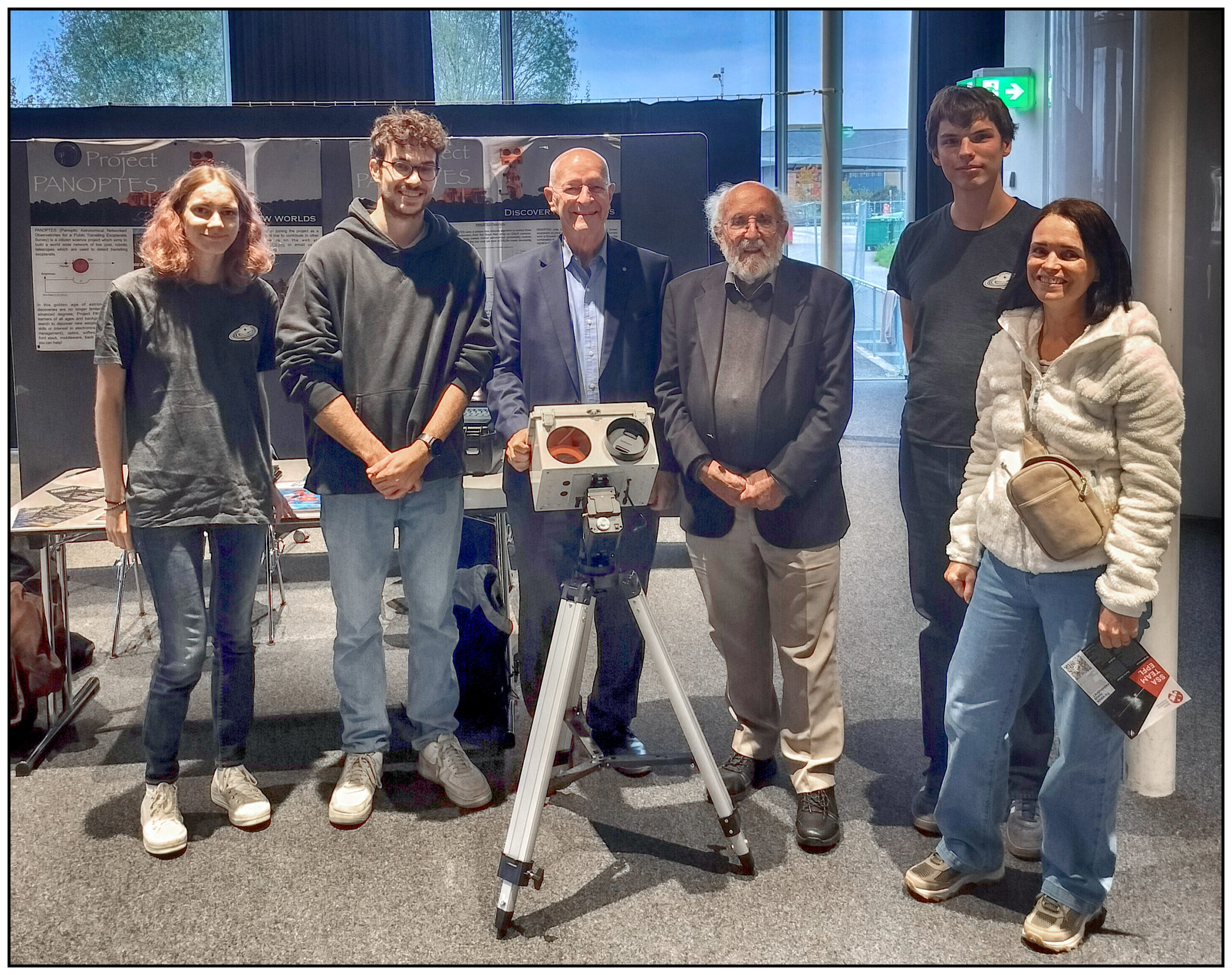
Celebrating 30 Years of the first Exoplanet Discovery with Physics Nobel Prize Michel Mayor and Panoptes Sponsor NASA Astronaut Claude Nicollier
Exoplanet Research
Project PANOPTES Newsletter
Introducing an International Newsletter
Dear PANOPTES Community,
We’re thrilled to announce the launch of our PANOPTES Newsletter — a space to share discoveries, creativity, and collaboration from across our growing global network. This newsletter will be published twice a month and will highlight the incredible work being done by our partners, students, and teams around the world…
Celebrating 30 Years of the first Exoplanet Discovery with Physics Nobel Prize Michel Mayor and Panoptes Sponsor NASA Astronaut Claude Nicollier
The PANOPTES project aims to make it affordable and accessible for anyone to build a robotic telescope capable of detecting exoplanet transits.
The student association Callista was contacted by Astropléiades, a Swiss astronomy organization, with the goal of installing a telescope as part of their educational astronomy trail near Vevey (Switzerland), funded by astronaut Claude Nicollier.
From there, we began researching the necessary components and exploring how to implement a new version of PANOPTES with our team at EPFL.
Telescope Installation
Our first step was to determine where and how to mount the telescope on campus. We chose the Cubotron, one of the tallest buildings at EPFL, which provided an ideal location for our initial tests before the telescope’s final installation at Astropléiades.
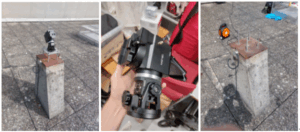
For the mount, we used the iOptron HAE 16C model, the selected model for this new version of PANOPTES. It was installed on one of the rooftop pylons, allowing the telescope’s “head” to be securely attached and remotely controlled to observe different areas of the sky.
To do this, we designed and manufactured a custom adapter plate to firmly attach the mount to the pylon.
→ iOptron HAE 16C mount → Mounting pylon (with and without the mount)
Component Selection and Design
For waterproofing reasons, the optical and electronic parts of the telescope are housed in a sealed enclosure. We did not need to build it ourselves, as we found commercially available boxes with the exact dimensions we required.
In parallel, we ordered the necessary hardware to continue the telescope’s design:
2 ZWO ASI294MM cameras : for image capture
2 ZWO LRGB 1.25″ filter wheels : to obtain color images
2 Canon-T2 adapters : to connect the cameras to the lenses
2 Rokinon SP 85 mm f/1.2 lenses
1 Raspberry Pi 5 : to control all the electronics in the camera box
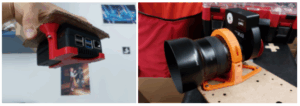
To keep all components securely in place inside the telescope, we 3D-printed custom mounts for each part.
→ 3D-printed Raspberry Pi mount → 3D-printed lens holder
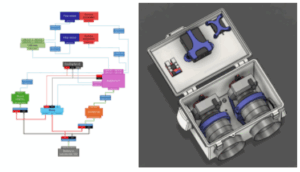
We also created a wiring diagram to anticipate the upcoming assembly and modeled all internal components in Fusion 360 to ensure perfect integration inside the enclosure.
→ 3D-printed supports for the Raspberry Pi, lenses, etc. → Wiring diagram
Preliminary Tests
Since delivery of the enclosure was delayed, we conducted several tests using laser-cut wooden plates with the same dimensions as the final box.
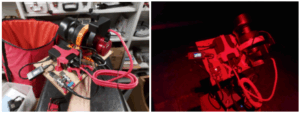
→ Full prototype setup with one of the two lenses and all electronics mounted on a wooden plate
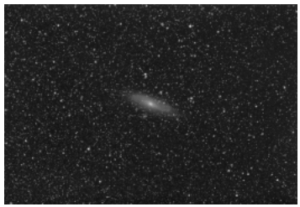
Using this setup, we captured our first image of the Andromeda Galaxy, with a single lens and computer-controlled operation.
Later, we took new photos of the same galaxy, this time using RGB filters, allowing us to produce beautiful color images!
As the first images showed significant optical aberrations, we considered reducing the aperture to improve quality, but that wasn’t possible with our lenses.
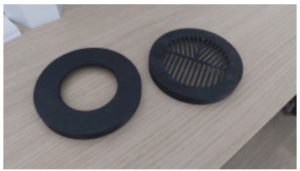
We are currently testing different masks on the lens hoods, one to reduce the aperture (left on the photo) and a Bahtinov mask (right on the photo) to help with focusing.
Current Version!
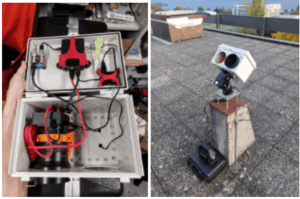
We finally received the enclosure, drilled openings for the lenses using a hole saw, mounted all electronics inside, and connected everything to our mount resulting in our current version of PANOPTES!
What’s Next?
We still have a few key steps before reaching the final version of the telescope, and we’ve already planned our next objectives:
Camera Box: Fix the mount waterproofing issue, improve the Raspberry Pi setup, and test the enclosure’s ventilation.
Battery Box (backup power): Confirm the wiring diagram and components.
→ Still to be ordered: sensors + ESP32 to alert the Raspberry Pi in case of a power outage. ● Weather Station: Design a small weather station to remotely control PANOPTES based on weather conditions.
Software: Update the current PANOPTES software for better compatibility and improved automation.
EPFL students Lynette Martin and Huckleberry Thums, along with Swiss NASA Astronaut Claude Nicollier who flew 5 STS Missions and repaired the Hubble Telescope, Physics Nobel Prize Winner Michel Mayor, joint discoverer of the First Exoplanet, along with EPFL student Achille Bach and PANOPTES Outreach Anne Chamberlain.
The PANOPTES Project continues to expand its global reach, uniting partners and student teams around the world — with particularly strong growth and enthusiasm across Africa.
Highlight of the Month
We were deeply honoured to be invited by EPFL in Lausanne, Switzerland, to take part in the celebration of the 30th anniversary of the first discovery of an exoplanet by Michel Mayor and Didier Queloz, Nobel Prize laureates in Physics. The original discovery was announced on October 6, 1995, marking a turning point in modern astronomy.
The invitation included an exclusive lunch organized by the Chair of Physics at EPFL and Achille Bach, President of Callista, the astronomy association at EPFL and a leading organizer of the PANOPTES initiative on campus. Alongside Michel Mayor, we had the great pleasure of Claude Nicollier — astronaut and long-time supporter of PANOPTES — joining us at the event. Achille Bach and his colleague Lynette Martin moderated the discussions, featuring Monika Lendl, Emeline Bolmont, Francesco Pepe, Claude Nicollier, Michel Mayor and David Ehrenreich
Regional & Global Updates
The Bhutan Initiative continues to develop, with students and educators leading remarkable work in both scientific and creative domains — a testament to the power of youth-led astronomy. Please see the featured video, a Bhutan Student production!
Meanwhile, Joe Wise, educator and Panoptes Initiative Mentor has been invited to India to support the creation of a new PANOPTES unit, expanding the project’s educational and observational footprint in South Asia.
Looking Ahead
We are currently developing a PANOPTES magazine, a publication designed to showcase contributions from students, faculty, and partners — blending science, art, and global perspectives.
At the end of this month, our team will also meet with donors in Switzerland, with the support of Claude Nicollier, whose vision and encouragement continue to inspire the PANOPTES community.
We warmly welcome contributions from everyone — current partners, prospective teams preparing to build their own units, educators, and students alike. Each edition will include:
– Science Features — articles on discoveries, research updates, and astronomical observations from the PANOPTES network. – Build Stories — updates from teams building or upgrading their telescopes. – Community Highlights — news from your region, university, or local community. – Student Voices — projects, leadership initiatives, and advocacy efforts led by students. – Culture & Perspectives — reflections on the intersection of science, culture, and faith. – The Arts — we’ll also celebrate creativity through art, photography, poetry, and writing competitions inspired by the night sky.
Our goal is to make the PANOPTES Newsletter a reflection of the diverse and inspiring people who make this project possible — uniting science, education, and creativity across borders. If you’d like to contribute an article, update, or creative piece, we’d love to hear from you! Together, we can show the world how curiosity, community, and imagination can reach for the stars (end Exoplanets).
Yours, The PANOPTES Team Empowering students and communities to explore the universe together